The max weight for 53' dry van loads is not printed on the trailer. The trailer has a rating from its builder, the law sets limits for the whole rig and each axle group, and your tractor's weight eats into what is left. This guide puts those numbers together, shows a worked scale ticket, and explains how to book heavy freight without getting overweight tickets or turned away at a scale.
The dry van weight limit: federal rules
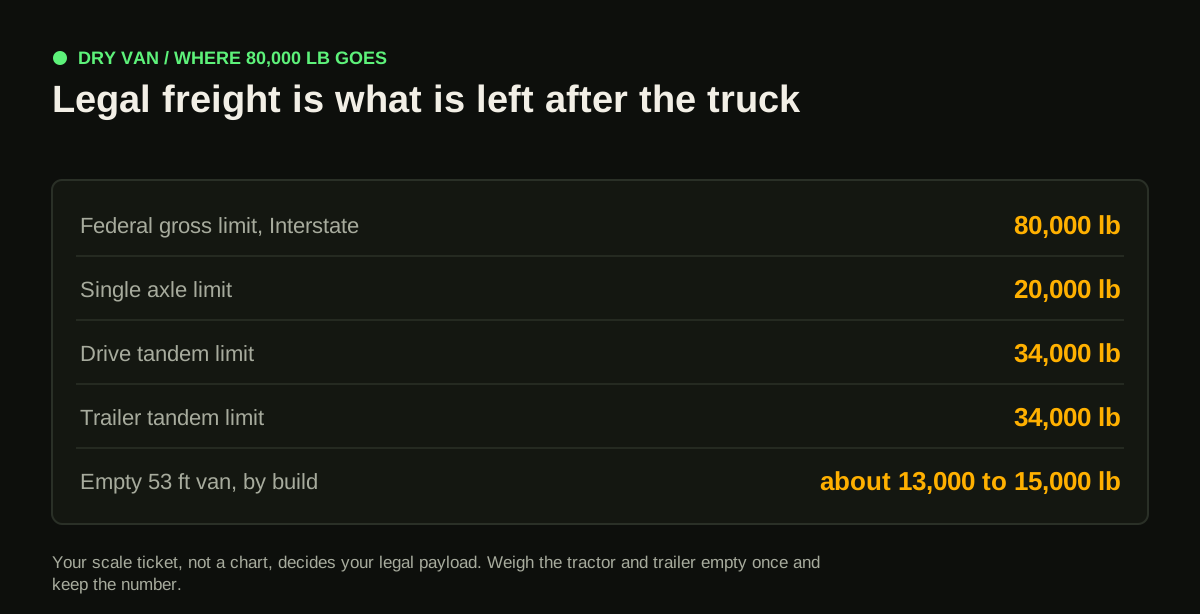
Federal rules in 23 CFR 658.17 set the limits for the Interstate system:
| Limit | Weight |
|---|---|
| Gross vehicle weight | 80,000 lb |
| Single axle | 20,000 lb |
| Tandem axle group | 34,000 lb |
| Bridge formula | Caps weight on any group of axles by their number and spread |
A tractor with a 53 ft van usually has five axles: a steer axle, two drive axles (a tandem) and two trailer axles (another tandem). That layout can reach 80,000 lb within the tandem limits when the steer axle carries roughly 12,000 lb. States set their own limits on roads off the Interstate, and some allow more, but most van freight is planned to 80,000.
How much does a 53 ft dry van trailer weigh?
Empty dry van trailer weight is roughly 13,000 to 15,000 lb. Real examples:
- 2020 Wabash DuraPlate van, dealer estimate
- 13,167 lb
- Typical 53 ft van, trailer dealer's guide
- about 15,000 lb
- Wabash DuraPlate HD rating (GVWR)
- 68,000 lb
- Wabash DuraPlate HD axle rating (GAWR)
- 20,000 lb
The GVWR is what the trailer is built to carry; the road limits are what the law lets you carry. On a five-axle rig, the law runs out first.
Weight of semi truck and trailer: the real calculation
Legal payload is simple subtraction once you know your empty weight. The catch is that you need it per axle group, not just in total.
- Steer axle
- 11,000 lb
- Drive tandem
- 13,500 lb
- Trailer tandem
- 9,000 lb
- Empty gross (sleeper tractor, full fuel, driver, 53 ft van)
- 33,500 lb
In that EXAMPLE the theoretical legal payload is 46,500 lb. In practice it is less. To use all of it, the drive tandem would need to take on 20,500 lb and the trailer tandem 25,000 lb, with the steer axle barely moving. Real pallets do not land that neatly. That is why most carriers plan to the low-to-mid 40,000s of pounds and ask the shipper for exact weights before taking anything heavier.
How weight lands on the axles
Where the freight sits in the van decides which axles carry it:
- Freight near the nose loads the tractor's drive axles and some of the steer axle.
- Freight near the doors loads the trailer tandem.
- Sliding the trailer tandems forward moves weight from the drive axles onto the trailer axles. Sliding them back does the opposite.
- Moving the fifth wheel shifts weight between the steer and drive axles.
A load that is legal in total can still be over on one tandem. In a typical EXAMPLE, 44,000 lb of heavy pallets loaded toward the nose puts the drives at 35,500 while the trailer tandem sits at 30,000. The fix is a tandem slide, a fifth wheel move, or a reload. Work it out before you leave with the tandem slide and fifth wheel weight shift calculator, or plan the pallets in the trailer load planner.
Remember the kingpin rule: California caps kingpin to rear axle at 40 ft for trailers with two or more axles, so you cannot slide the tandems all the way back on loads into or through that state.
Quad axle and spread axle vans
A standard dry van has a closed tandem. Some trailers carry three or four axles, or a spread axle set about 10 ft apart. More axles help when freight is dense, because they spread the weight under the bridge formula. They do not raise the 80,000 lb gross cap on the Interstate, unless a state's grandfathered rules allow it on specific routes. Several states allow much heavier multi-axle combinations on their own highways under state permits and rules. Quad axle dry van hauling capacity is therefore a state question, not a trailer question. Read the state's rules before you quote a heavy load that depends on them.
Dry van capacity: weight vs space
A 53 ft van holds 26 standard pallets on the floor and roughly 3,800 to 4,000 cubic feet. Divide 45,000 lb by 26 pallets and you get about 1,730 lb per pallet. Freight lighter than that fills the trailer before it hits the weight limit. Heavier freight hits the limit with floor left over. Canned goods, beverages, paper rolls and tile are typical weight-outs. The space side is covered in 53' dry van dimensions.
How to book heavy van loads safely
- Weigh your empty rig once on a certified scale with full fuel, and keep the ticket.
- Get the real freight weight from the shipper, not an estimate. Ask how it is loaded.
- Scale after loading at the first certified scale, before the highway.
- Fix axle weights at the shipper if you can. Sliding tandems is free; reworking a load at a weigh station is not.
- Know the overweight terms. Who pays for a reload or fine if the shipper's weight was wrong?
- Watch fuel. Diesel weighs about 7 lb a gallon. A full tank versus a half tank can be worth a few hundred pounds of payload.
What overweight costs you
Overweight tickets, out-of-service orders and the time spent at a scale or shifting freight all come out of the load's pay. Heavy freight can pay well, but only when the weight was checked before the rate con was signed. More on the dry van market in general in dry van loads and load boards, the dry van trailer guide and the dry van guide.
Questions carriers ask
01How much does a 53 ft dry van trailer weigh empty?
Roughly 13,000 to 15,000 lb, depending on walls, floor, suspension and options. One dealer listing estimates a 2020 Wabash plate van at 13,167 lb empty, and a trailer dealer's guide puts a typical 53 ft van at about 15,000 lb. Weigh yours on a certified scale to know for sure.
02What is the max weight for a dry van?
The trailer has a manufacturer's rating, often 65,000 to 68,000 lb GVWR, but the road limit is usually lower. On the Interstate the whole rig is capped at 80,000 lb gross, so the van's legal freight weight is what is left after the tractor and trailer, usually low-to-mid 40,000s of pounds.
03How much does a semi truck and trailer weigh empty?
It depends on the tractor more than the trailer. A sleeper tractor with full fuel plus a 53 ft van commonly weighs in the low to mid 30,000s of pounds. A day cab is lighter. A scale ticket of your empty rig is the only number to plan with.
04What is quad axle dry van hauling capacity?
More axles do not raise the 80,000 lb federal gross limit on the Interstate. They spread weight under the bridge formula and help with axle limits. Some states allow heavier multi-axle combinations on their own roads under state law, so a quad axle van's capacity depends on the state and the route.
05Can I haul 45,000 lb in a dry van?
Sometimes. If your tractor and trailer weigh 35,000 lb or less together and the load is spread so no tandem goes over 34,000 lb, 45,000 lb of freight fits under 80,000 lb. A heavy tractor or poor pallet placement can make the same load illegal.
SOURCES
- eCFR, 23 CFR 658.17: Federal weight limits on the Interstate: 80,000 lb gross, 20,000 lb single axle, 34,000 lb tandem, bridge formula (checked 2026-10)
- Hale Trailer, Dry Van Dimensions & Capacity Guide (Aug 26, 2025): 53 ft van: inside about 52 ft 6 in x 99-101 in x 108-110 in; door opening about 98 x 108-110 in; 26 pallets single stack (up to 28 turned); about 3,800-4,000 cu ft; empty weight about 15,000 lb; payload commonly up to about 44,000-45,000 lb (checked 2026-10)
- iTag Equipment dealer listing: 2020 Wabash 53 ft DuraPlate dry van, air ride, swing doors: estimated empty weight 13,167 lb (dealer estimate, used unit) (checked 2026-10)
- Wabash DuraPlate HD dry van specifications (dealer copy): 53 ft x 102-3/8 in x 13 ft 6 in; GVWR 68,000 lb; GAWR 20,000 lb (checked 2026-10)
- Caltrans, Legal Truck Access: Vehicle Lengths: Semitrailer KPRA may not exceed 40 ft with two or more axles (38 ft with one axle); cities and counties may restrict to 38 ft (checked 2026-10)
SOURCE: Primary sources listed above, checked on the dates shown.