The 53' dry van is the standard box of American freight. Shippers build their loads around it, brokers quote by it, and most dock doors are sized for it. Knowing its exact dimensions saves you from the two classic headaches: freight that will not fit through the doors, and a load that fits but runs overweight. This page has the numbers, where they come from, and what they mean when you book a load.
Standard 53' dry van dimensions at a glance
| Measurement | Feet and inches | Inches |
|---|---|---|
| Outside length | 53 ft | 636 in |
| Outside width | 8 ft 6 in | 102 in |
| Overall height (common build) | 13 ft 6 in | 162 in |
| Inside length | about 52 ft 6 in | about 630 in |
| Inside width | 8 ft 3 in to 8 ft 5 in | 99 to 101 in |
| Inside height | 9 ft to 9 ft 3 in | 108 to 111 in |
| Rear door opening (swing doors) | about 8 ft 2 in wide × 9 ft to 9 ft 2 in high | about 98 × 108 to 110 in |
| Pallets, 48 × 40, single stack | 26 straight, up to 28 turned | |
| Cubic capacity | about 3,800 to 4,000 cu ft |
Figures are typical for current 53 ft vans with swing doors, from Wabash's DuraPlate product sheet (inside width 101 in, inside height 110-1/4 in front and 111-1/4 in rear) and a trailer dealer's published dimension guide. Real trailers vary by builder, wall type, year and options.
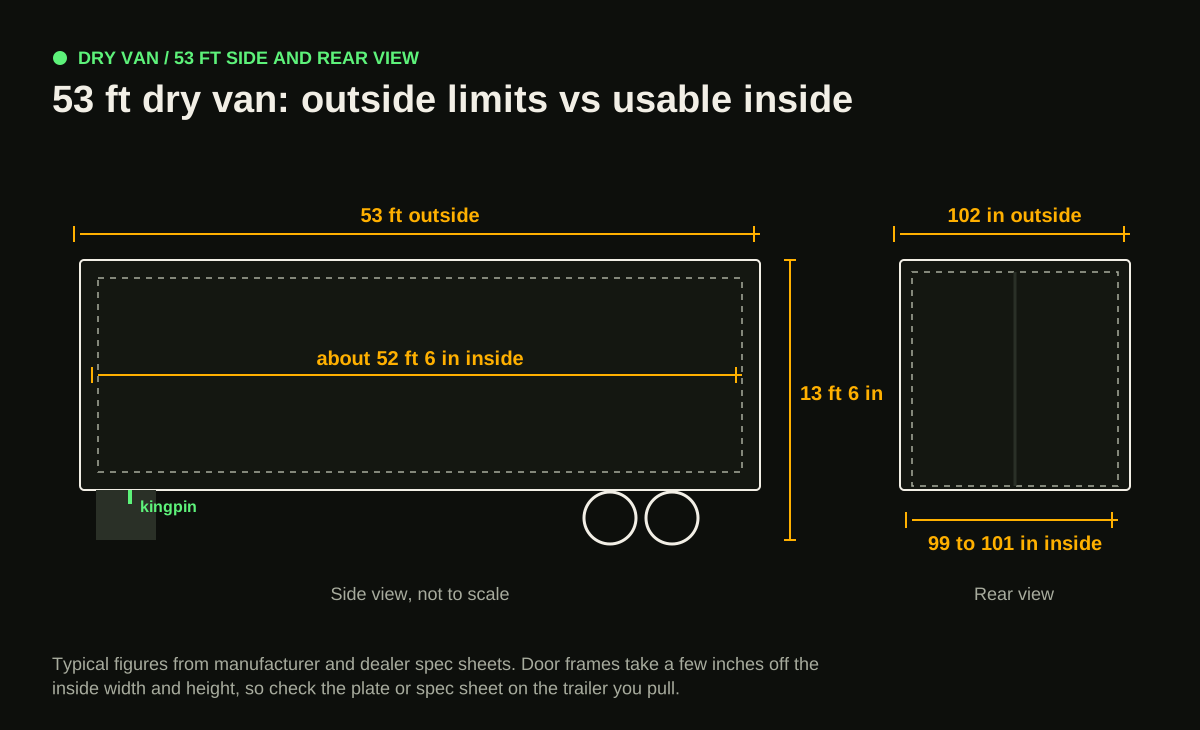
Why the outside numbers are what they are
Three of the outside numbers come from law, not design:
- Width, 102 in. Federal rule 23 CFR 658.15 sets 102 in as the width states must allow on the National Network. Safety devices like mirrors and lights do not count toward it.
- Length, 53 ft. Federal rule 23 CFR 658.13 says states cannot hold a semitrailer under 48 ft on the National Network; most states allow 53 ft. There is no federal limit on the overall length of a tractor with one semitrailer; the whole rig usually runs 65 to 75 ft, worked out in semi truck length with a 53' trailer.
- Height, 13 ft 6 in. There is no federal height limit. States set their own, most between 13 ft 6 in and 14 ft, so builders design vans to the lowest common number.
One more legal number matters on a 53 ft van: the distance from the kingpin to the rear axle. California, for one, caps it at 40 ft for semitrailers with two or more axles. That is why you see "California legal" marks on trailer tandems and a hole where the tandems must not slide past. Check the state rules for your lanes before you slide the tandems all the way back.
Inside dimensions: where the inches go
Outside is 102 in; inside is 99 to 101 in. The difference is the walls. Composite plate walls are thin, so the inside is close to 101 in. Older sheet-and-post vans and vans with lots of logistic track lose more (see how a plated trailer compares). That gap decides whether two pallets fit side by side when they run slightly oversized, and whether a 100 in wide crate fits at all.
Inside height has a catch too. The rear door frame sits lower than the ceiling, so a load that clears the inside height can still hit the header at the door. Measure the tallest item against the door opening, not the ceiling.
Floors are usually hardwood or composite, and every van has a rated floor load for forklifts. Dealer listings for one major builder's vans show 20,000 lb on some models and 24,000 lb on heavier fleet specs. If a shipper loads with heavy forklifts, that rating matters.
How many pallets fit in a 53' dry van
- Inside length
- about 630 in
- Straight: 48 in deep, 2 across
- 13 rows × 2 = 26
- Turned: 40 in deep, 2 across
- 15 rows × 2 = 30
- Double stacked, straight
- 52
Most freight is quoted as full truckload (FTL) at 26 pallets or by linear feet for partial loads. For other pallet sizes and mixed patterns, use the trailer load planner or check whether a specific piece fits with the dimension fit checker.
Dry van sizes beyond the 53 foot dry van trailer
Not every van is a 53. You will still see:
| Size | Typical use | Notes |
|---|---|---|
| 53 ft × 102 in | Most truckload freight | The standard |
| 48 ft × 102 in | Older fleets, some regional work | 24 pallets single stack; fewer loads require it |
| 28 ft "pup" | Doubles and LTL | Pulled in pairs, mostly by LTL carriers |
| 26 ft box truck | Local and regional | A straight truck, not a semitrailer; 26 ft is the smallest we dispatch |
We cover 48 vs 53 in more depth on 48 foot trailer vs 53 and the trailer itself in dry van trailer.
What the dimensions mean for the loads you book
Space and weight are two different limits. A 53 ft van full of paper towels "cubes out": the trailer is full, but light. A van with 18 pallets of canned food "weighs out": half the floor is empty, but you are at the legal limit. Brokers will ask about your trailer for both reasons. Know these numbers about your own van:
- Inside width at the narrowest point, usually at the door frame.
- Inside height at the door, not just the ceiling.
- Empty weight, from a scale ticket, so you know your real legal payload. The max weight for a 53' dry van guide shows how to work it out.
- Whether you have logistic posts, straps and load bars to secure partial loads.
- Whether your tandems slide, and where the legal stop is for California.
Dry van height and low clearances
A 13 ft 6 in van fits under most bridges and into most docks. The trouble spots are older city routes, parking structures and some rural overpasses. A truck GPS set to your real height helps, but posted clearance signs always win. Many states allow 14 ft, yet the trailer is still 13 ft 6 in, so the extra room is a margin, not a reason to load higher.
For the wider picture of the dry van business, rates and freight types, see the dry van guide.
Questions carriers ask
01How tall is a dry van trailer?
Most 53 ft dry vans are built to 13 ft 6 in overall height, the most common state limit. Inside height is usually 108 to 111 in. One manufacturer's spec lists 110-1/4 in at the front and 111-1/4 in at the rear, because the floor sits slightly lower toward the back.
02How wide is a 53' dry van?
102 in outside, which is the federal width limit on the National Network. Inside, sidewall to sidewall, expect 99 to 101 in depending on the wall material. Thin-wall composite vans get closer to 101 in; older sheet-and-post vans have less.
03How many pallets fit in a 53 ft dry van?
26 standard 48 × 40 in pallets loaded straight in two rows, single stacked. Turning some pallets can get you to 28 or more if the freight allows it. Stack pallets two high and the count doubles, if the weight stays legal.
04How many cubic feet is a 53 ft dry van?
About 3,800 to 4,000 cubic feet, depending on the inside height and width of the specific trailer. In practice, weight or floor space usually runs out before cubic capacity does.
05Is a 53 ft truck the same as a 53 ft trailer?
No. When people say "53 ft truck" they usually mean a tractor pulling a 53 ft trailer. The whole rig is much longer, depending on the tractor's wheelbase and sleeper, and there is no federal overall length limit for a tractor with one semitrailer on the National Network.
SOURCES
- Wabash, DuraPlate dry van product sheet: 53 ft x 102-3/8 in x 13 ft 6 in; interior width 101 in sidewall to sidewall; interior height 110-1/4 in front, 111-1/4 in rear (checked 2026-10)
- Hale Trailer, Dry Van Dimensions & Capacity Guide (Aug 26, 2025): 53 ft van: inside about 52 ft 6 in x 99-101 in x 108-110 in; door opening about 98 x 108-110 in; 26 pallets single stack (up to 28 turned); about 3,800-4,000 cu ft; empty weight about 15,000 lb; payload commonly up to about 44,000-45,000 lb (checked 2026-10)
- eCFR, 23 CFR 658.15: Federal vehicle width: 102 in on the National Network (checked 2026-10)
- eCFR, 23 CFR 658.13: Length: states must allow semitrailers of at least 48 ft (longer where grandfathered) in a tractor-semitrailer combination on the National Network, with no overall length limit for that combination (checked 2026-10)
- FHWA, Federal Size Regulations for Commercial Motor Vehicles: No federal height limit; states set their own, most between 13 ft 6 in and 14 ft (checked 2026-10)
- Caltrans, Legal Truck Access: Vehicle Lengths: Semitrailer KPRA may not exceed 40 ft with two or more axles (38 ft with one axle); cities and counties may restrict to 38 ft (checked 2026-10)
SOURCE: Primary sources listed above, checked on the dates shown.