A dry van trailer looks like a plain box, and that is the point. Under the paint, though, vans differ in ways that change what freight you can take, how long the trailer lasts and what you get back when you sell it. This guide covers how dry van semi trailers are built, the main types and options, who makes them, what they cost and what to check before you buy or lease one. For exact inside and outside numbers, see 53' dry van dimensions.
What is a dry van trailer?
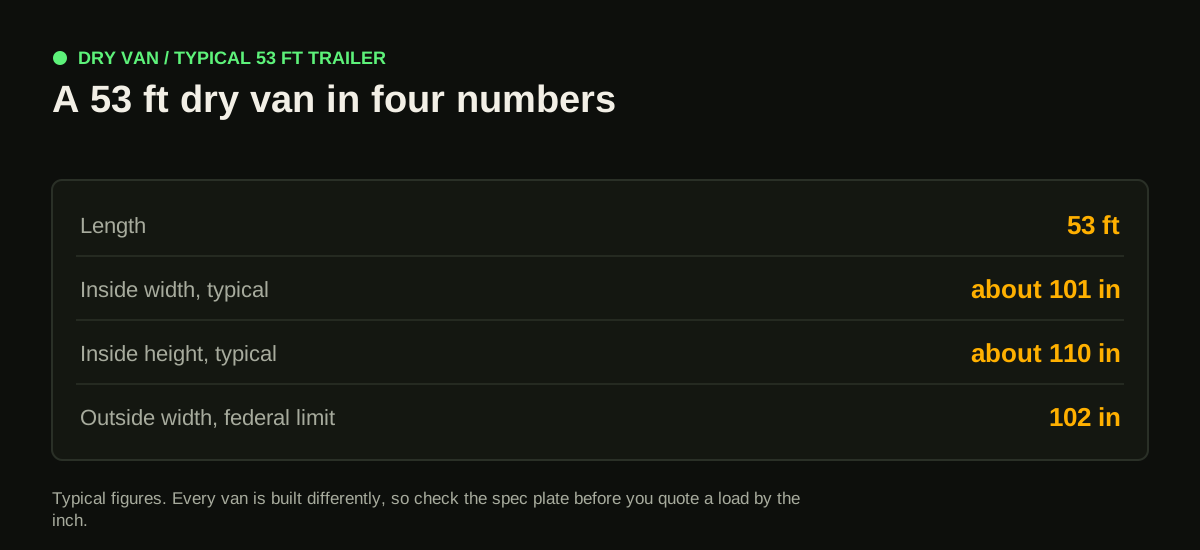
It is an enclosed, unrefrigerated semi trailer that rides on a tractor's fifth wheel at the front and its own axles at the back. Freight goes in through rear doors at a loading dock. Most dry van trailers are 53 ft long and 102 in wide, the federal width limit, and about 13 ft 6 in tall. Inside you get roughly 101 in of width on a plate van and about 110 in of height.
How a dry van is built
| Part | Common choices | What it changes for you |
|---|---|---|
| Walls | Plate or composite panels; sheet and post (aluminum on posts) | Inside width, damage resistance, repair method |
| Roof | Aluminum sheet, sometimes translucent | Light inside; roof damage from low clearances |
| Floor | Hardwood (oak), composite or hybrid; rated for forklift loads | Forklift capacity, water damage, food-grade loads |
| Doors | Swing doors or roll-up door; some have vents (vented vans) | Swing opens wider and seals better; roll-up helps at tight docks |
| Suspension | Air ride or spring | Fragile freight, some shippers require air ride |
| Tandems | Sliding or fixed, spread or closed | Weight distribution, state kingpin rules |
| Logistic track | E-track or posts along the walls | Securing partial and mixed loads |
| Tires and extras | Inflation systems, side skirts, tails, a GPS tracker | Fuel use, roadside tire trouble, finding dropped trailers |
Plate vs composite vs sheet and post. Composite plate walls are the most common choice on new vans because they give more inside width and take forklift bumps without tearing. Sheet and post vans are lighter on some builds and easy to patch, but lose inside width to the posts. Each builder has its own panel name and claims about weight and strength. The full side-by-side is in plated trailer vs sheet and post.
Floor ratings. One heavy-duty van spec lists a gross vehicle weight rating of 68,000 lb and a 20,000 lb axle rating. Floors carry a separate forklift rating. If shippers load with heavy forklifts or you haul dense freight, buy the higher floor rating; floor repairs are slow and expensive.
Tandems and the kingpin rule. Sliding tandems let you move weight between the drive axles and the trailer axles. On California routes, the kingpin to rear axle distance cannot exceed 40 ft for trailers with two or more axles, so vans carry a marked stop.
Dry van trailer types
- 53 ft van. The standard for truckload freight.
- 48 ft van. Older fleets and some regional work. Fewer loads require it.
- 28 ft pup. Pulled in pairs as doubles, mostly by LTL carriers.
- Vented van. Vents for produce that does not need cooling.
- Van with liftgate. For deliveries without docks.
- Food-grade van. A clean van kept for food loads, often a policy, not a build.
- Heavy-duty spec. Higher floor rating and stronger frame for dense or rough-handled freight.
Dry van trailer manufacturers
The big US builders of dry vans include Wabash, Great Dane, Utility Trailer, Hyundai Translead, Stoughton and Vanguard. All build 53 ft vans in plate and sheet-and-post styles with similar options. Differences are in panel technology, frame design, dealer network and resale value in your area. Parts and repair shops near your lanes matter more than the logo. A trailer you cannot get fixed quickly costs you loads.
What a new dry van trailer costs
- Vanguard VXP, FET included, at the factory
- $36,759
- Wabash DVCVHPC, dealer in Washington
- $38,250
- Wabash DVHDHPC, heavy-duty spec, Portland
- $43,250
On top of the price, budget for federal excise tax if it is not included, registration and plates, a tire inflation system or skirts if your fuel savings justify them, and insurance. Most owner-operators finance, lease or buy used instead. See used dry van trailers and dry van trailer leasing.
What to check before you buy or lease one
- Floor. Soft spots, broken boards, water damage and the forklift rating.
- Walls and roof. Holes, delamination on plate panels, roof patches and leaks. Stand inside with the doors shut and look for light.
- Doors and seals. Hinges, cams, lock rods and seals. A van that leaks gets rejected at food and paper shippers.
- Frame, crossmembers and landing gear. Cracks, rust and bent crossmembers.
- Suspension and tandems. Air bags, slider pins that move, and a readable California stop mark.
- Brakes, ABS and lights. An ABS light on the trailer is a roadside inspection waiting to happen.
- Tires. Matching, tread depth, sidewall damage.
- Paperwork. Title, the most recent annual inspection, and the spec sheet or plate with GVWR and axle ratings.
Use the dimension fit checker to test the inside width and height you measure against the freight you expect.
What your trailer means for the loads you book
Brokers ask three questions about a van: is it 53 ft, does it have air ride, and is it clean? Many add: does it have straps or load bars, is it food grade, and does it have a swing door. A clean 53 ft air-ride van with swing doors and logistic posts can take almost any dry load on a board. Each missing item quietly removes loads from your options.
Owning a trailer vs power only
Owning a van gives you access to every dry load posted. It also brings a payment, repairs, tires, insurance and a trailer to inspect and keep clean. Pulling other companies' trailers through power only trades that for a narrower set of loads. The dry van business as a whole is covered in our dry van guide.
Questions carriers ask
01What is a dry van trailer?
It's a fully enclosed box trailer, without temperature control, that a tractor pulls. It protects freight from weather and theft and is loaded through rear doors, almost always at a dock with forklifts and pallets. It's the most common semi trailer in the US.
02What is a plated dry van trailer?
A plate trailer has walls made of composite panels, a plastic core between thin steel skins, instead of aluminum sheets riveted to posts. The walls are thinner, so the inside is wider, and the panels resist forklift damage. Some people also say "plated trailer" to mean a trailer with its own license plate; that's a different topic.
03How much does a new dry van trailer cost?
Dealer listings for new 2026 53 ft dry vans in October 2026 ran from about $36,800 at the factory to about $43,300 for a heavy-duty spec. Many dealers list "call for price," and fleet orders get volume pricing, so treat those as asking prices.
04What are the types of dry van trailers?
By length: 53 ft (most freight), 48 ft and 28 ft pups for doubles. By wall: plate or composite, and sheet and post. By door: swing or roll-up. Plus options like vented vans, liftgates and food-grade setups.
SOURCES
- Wabash, DuraPlate dry van product sheet: 53 ft x 102-3/8 in x 13 ft 6 in; interior width 101 in sidewall to sidewall; interior height 110-1/4 in front, 111-1/4 in rear (checked 2026-10)
- Wabash DuraPlate HD dry van specifications (dealer copy): 53 ft x 102-3/8 in x 13 ft 6 in; GVWR 68,000 lb; GAWR 20,000 lb (checked 2026-10)
- Hale Trailer, Dry Van Dimensions & Capacity Guide (Aug 26, 2025): 53 ft van: inside about 52 ft 6 in x 99-101 in x 108-110 in; door opening about 98 x 108-110 in; 26 pallets single stack (up to 28 turned); about 3,800-4,000 cu ft; empty weight about 15,000 lb; payload commonly up to about 44,000-45,000 lb (checked 2026-10)
- TruckPaper and MyLittleSalesman dealer listings: New 2026 53 ft dry vans listed at $36,759 (Vanguard VXP, FET included, FOB factory) to $38,250 (Wabash DVCVHPC) and $43,250 (Wabash DVHDHPC heavy-duty spec); many dealers list call for price (checked 2026-10)
- Caltrans, Legal Truck Access: Vehicle Lengths: Semitrailer KPRA may not exceed 40 ft with two or more axles (38 ft with one axle); cities and counties may restrict to 38 ft (checked 2026-10)
- eCFR, 23 CFR 658.15: Federal vehicle width: 102 in on the National Network (checked 2026-10)
SOURCE: Primary sources listed above, checked on the dates shown.